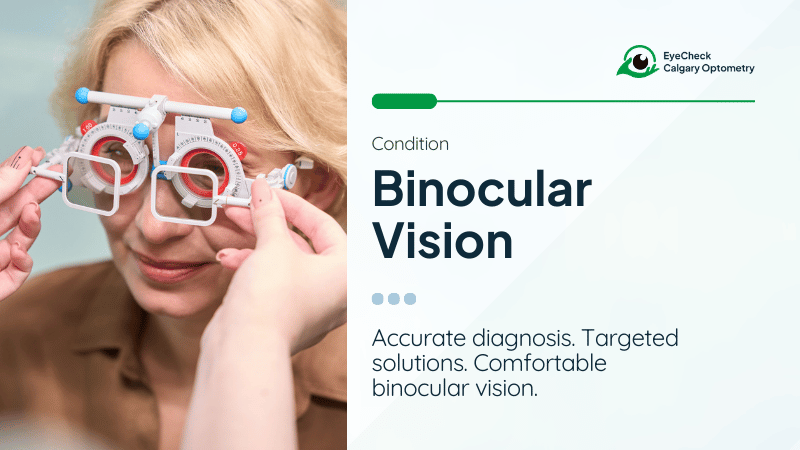
At EyeCheck Calgary Optometry, binocular vision treatment is designed for patients who see clearly but still struggle with symptoms like headaches when reading, eye strain on screens, double vision, and difficulty focusing.
If words move on the page, you lose your place while reading, or your eyes feel tired after near work, the issue may not be your prescription, it may be how your eyes coordinate as a team.
We perform a dedicated binocular vision workup and translate those clinical findings into a structured treatment program built to restore comfortable, efficient vision.
Binocular vision assessments and treatment are available now at EyeCheck Calgary Optometry. To book an assessment or discuss your symptoms, please contact EyeCheck Calgary Optometry.
Binocular Vision Assessment & Treatment for Headaches, Eye Strain & Double Vision in Calgary
Binocular vision is the ability of both eyes to work together as a coordinated system. It is not just about seeing clearly. It is about how accurately the brain combines two images into one stable, three dimensional perception of the world.
For this system to function properly, several processes must work in sync. The eyes must align precisely on a target. They must adjust focus quickly and efficiently as distance changes. They must also move smoothly when tracking words on a page or objects in motion.
When these systems are balanced, vision feels effortless. Reading is comfortable. Screens do not cause fatigue. Depth perception remains stable.
When they are not, the brain must work harder to maintain single vision. Over time, that extra effort can reduce visual stamina and create discomfort during sustained tasks such as reading, studying, or computer use.
Binocular vision dysfunction often goes unnoticed because patients are told their eyesight is clear. However, clarity alone does not guarantee that the eyes are coordinating efficiently.
When the visual system is under strain, symptoms tend to appear during sustained tasks such as reading, studying, computer work, or driving. These symptoms may be subtle at first and gradually worsen over time.
You may recognize some of the following:
Children may avoid homework, complain that reading feels tiring, or struggle with sustained focus. Adults often attribute symptoms to stress, long work hours, or screen exposure. In many cases, the underlying issue is a coordination imbalance between the eyes.
When vision requires conscious effort to remain single and clear, it is a sign that the binocular system may not be functioning as efficiently as it should.
A binocular vision workup is different from a routine comprehensive eye exam. While a standard exam evaluates visual clarity and overall eye health, a binocular vision evaluation focuses on how the visual system performs under sustained demand. This includes the types of stress that trigger headaches during reading, double vision with fatigue, eye strain from computer use, and difficulty maintaining focus. At EyeCheck Calgary Optometry, we use detailed, practitioner led clinical testing to identify the underlying cause of these symptoms so that treatment decisions are based on measurable findings.
Your binocular vision assessment may include:
This battery of manual tests allows us to assess the three pillars of binocular vision: vergence, accommodation, and ocular motility. Together, these findings provide a comprehensive understanding of visual coordination, stamina, and neurological efficiency.
Treatment begins by translating clinical findings into a structured program tailored to the specific diagnosis. Rather than offering generalized exercises, we design a regimen based on measurable data obtained during the binocular vision assessment.
As described in our clinical process, we utilize what we call a load and progress philosophy. The visual system improves through structured repetition and progressively increased challenge. Similar to strength training, the goal is to build stable neurological pathways so that maintaining single vision becomes automatic rather than effortful.
Treatment is often dual pronged.
In some cases, corrective lenses or prism may be prescribed to reduce immediate strain. This can provide relief from double vision, headaches, or visual instability while the underlying coordination imbalance is being addressed.
Active treatment involves structured visual training, commonly referred to as vision therapy. These programs are typically home based and designed to strengthen specific visual systems such as convergence, accommodation, or eye movement control.
Examples may include:
Progress is monitored through in office follow up evaluations. During these visits, sensory and motor findings are reassessed and the level of challenge is adjusted accordingly. Resistance may be increased using stronger prisms, smaller print, or greater visual demand to ensure continued improvement.
Most patients reach a functional plateau within approximately twelve to sixteen weeks, although duration varies depending on severity and consistency. The ultimate goal is what we describe as a functional cure. This means the patient no longer expends conscious effort to maintain single, comfortable vision and the original symptoms have resolved.
At Eye Check Calgary, we treat every exam as an opportunity to uncover more than just vision issues. With advanced technology and a proactive mindset, we help you stay ahead of preventable problems and live with greater confidence in your care.

We use 3D OCT scans and fundus photography for all ages—not just when there's a problem. This helps us detect issues like glaucoma, macular degeneration, and optic nerve inflammation early.

All seniors receive visual field testing, helping us detect past strokes or neurological issues that may have gone unnoticed. This proactive approach allows us to coordinate timely care with your family doctor or specialists if needed.

Children often can’t describe their vision issues. That’s why we give them the same detailed exams as adults, helping catch problems before they affect learning and development.

When a patient’s scan shows a serious concern—like papilledema or signs of a retinal detachment—we act fast. We've coordinated emergency care, even calling ambulances when needed.

Our team has the freedom to go above and beyond. If someone’s in crisis or can’t afford care, we make it right—because kindness should never come with a price tag.
Prism lenses are considered a passive form of treatment. They can help reduce strain and improve comfort by compensating for misalignment. However, they do not strengthen the underlying coordination system. Active treatment, often referred to as vision therapy, involves structured visual training designed to improve alignment control, focusing flexibility, and eye movement accuracy. In some cases, both approaches are used together as part of a comprehensive plan.
The duration of treatment varies depending on the severity of the condition and patient consistency. Many patients reach meaningful improvement within approximately twelve to sixteen weeks. More complex cases may require a longer program. Progress is monitored through follow up evaluations, and adjustments are made using our load and progress philosophy to ensure measurable improvement. The goal is long term stability rather than temporary symptom relief.
No. A routine comprehensive eye exam evaluates visual acuity, prescription needs, and overall eye health. A binocular vision workup is more specialized and focuses specifically on how the eyes coordinate as a neurological system. It includes detailed assessment of alignment, focusing flexibility, and eye movement control. Because binocular dysfunction can be subtle, it often requires practitioner led clinical testing that goes beyond automated screening or basic vision checks.
Book your comprehensive eye exam in Calgary with Eye Check Calgary. Whether it’s digital eye strain, dry eyes, diabetes-related vision concerns, or a contact lens fitting, we’ll guide you through every step with care and clarity. Call us today at 587-441-5254.

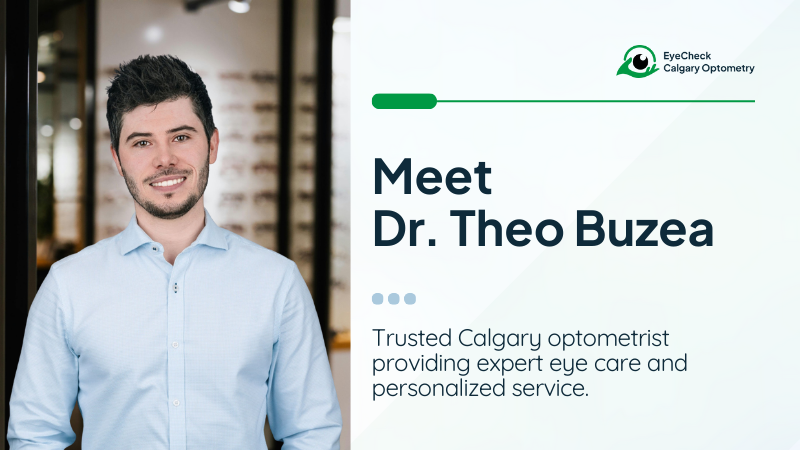
Comprehensive eye care in Calgary, led by Dr. Theo Buzea. We provide full-scope optometry services for all ages, including routine eye exams, contact lens fittings, dry eye assessments, and advanced diagnostic testing. Our clinic is equipped with state-of-the-art imaging technology to detect and manage conditions like glaucoma, diabetic retinopathy, macular degeneration, and myopia.
At Eye Check Calgary, your vision health is our priority. Whether you need a back-to-school eye exam for your child, ongoing care for a chronic condition, or emergency eye treatment, our team makes the process simple, thorough, and stress-free. With direct billing, seniors’ and children’s coverage, and same-day appointments available, protecting your eyesight has never been easier.
Book your next Calgary eye exam today and experience personalized care from Dr. Theo Buzea and the Eye Check team.